
A Gogol t-shirt gives literary satire a quiet form: a minimalist print places a short idea on an everyday garment. According to the Getty Research Institute, Nikolay Gogol was a Russian writer and theorist, born in Ukraine, who lived from 1809 to 1852. His name carries a tradition of wit that can make the ordinary feel newly strange.
A Gogol t-shirt doesn’t need to explain its joke. A restrained print can leave room for recognition and the sharper thought beneath the first impression. That balance is part of its appeal: a literary reference without visual noise.
This article explores what Gogol-inspired prints can express, how minimalist design gives satire its space, and what to notice when choosing a design. The focus is on the quiet exchange between text and image: a fragment of literature, pared back until its wit comes forward.
Key Takeaways
- Look for prints where a brief literary phrase carries the wit without explaining the joke.
- Notice how minimal typography and open space shape the tone of a design.
- Read the print as a meeting of satire and the everyday, not merely as a literary reference.
- Choose a literary-quote oversized T-shirt when you want a restrained design with an idea behind it.
Gogol t-shirt
Nikolay Gogol was a Russian writer and theorist, born in Ukraine, who lived from 1809 to 1852, according to the Getty Research Institute. The Museum of New Zealand Te Papa Tongarewa gives his birth date as 31 March 1809 and his death date as 4 March 1852. These details place his writing across cultures and periods. A print bearing his name can suggest more than literary admiration. It can signal a taste for comedy that turns toward unease.
Gogol’s satire often begins with something familiar, then unsettles it. In The Nose, an ordinary feature of the body becomes an absurd social presence. In The Government Inspector, fear of exposure sends officials into comic confusion. These premises suit a restrained garment print: the humour depends on a sharp idea, not an elaborate image. A short phrase can invite recognition while leaving its meaning open.
His fiction also finds the strange in daily life. The Overcoat centres on a clerk and a garment that takes on meaning beyond its practical use. That contrast offers a useful lens for literary clothing. A shirt is ordinary; a compact quotation can interrupt that ordinariness with irony, observation or a hint of absurdity. The effect rests on the tension between what you notice first and what the words suggest afterward.
Minimal design gives that tension room. A short line of text can feel like a private remark rather than a proclamation. Sparse typography keeps attention on the phrase, while open space lets its meaning stand out. Consider a design with one brief quotation and no explanatory illustration. You read the words first, sense their tone, then connect them to Gogol’s comic vision. The reference is clear without turning the shirt into a plot summary.
What the print can express
A literary print can communicate several things at once. Its meaning depends on the wording, the visual treatment and your familiarity with Gogol. Look for these signals:
- Satire: A phrase may expose vanity, status, or social performance through an understated joke.
- Absurdity: A strange observation can echo the dislocation found in The Nose.
- Literary recognition: Gogol’s name can signal an affinity with Russian literature and its comic unease.
- Restraint: A simple layout lets the idea carry the print instead of decorative imagery.
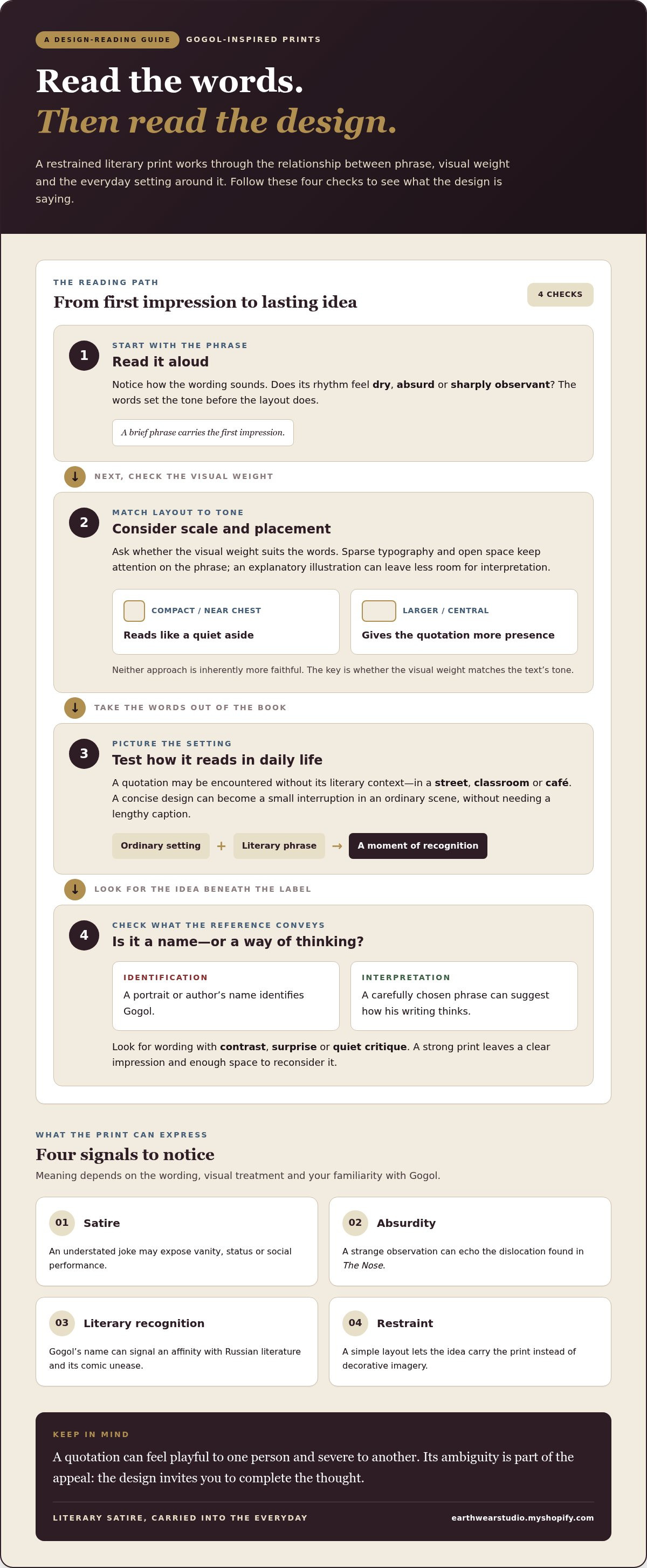
These signals don’t have fixed meanings. A quotation can seem playful to one person and severe to another. That ambiguity is part of the design’s appeal. A print that explains every reference leaves little room for interpretation; a carefully chosen phrase invites you to complete the thought. Gogol’s satirical world rewards that pause, since humour and discomfort often sit close together.
When assessing a design, start with the words. Read the phrase aloud and notice whether its rhythm feels dry, absurd or sharply observant. Then consider its scale and placement. A compact print near the chest can read like a quiet aside; a larger central line gives the quotation more presence. Neither approach is inherently more faithful. Ask whether the visual weight matches the text’s tone.
Consider how the reference works beyond a literary setting. A quotation on a shirt enters a street, classroom or café, where people encounter it without a full explanation. That distance can strengthen the satire. The print becomes a small interruption in an ordinary scene, much like Gogol’s fiction makes the familiar seem unstable. A successful design needs no lengthy caption to create that effect.
Finally, distinguish a literary reference from a decorative name. A portrait or author’s name identifies Gogol, while a carefully chosen phrase can suggest how his writing thinks. Look for wording with contrast, surprise or quiet critique. Minimalism doesn’t make the idea shallow; it concentrates attention. A strong print leaves one clear impression and enough space to reconsider it.
Earthwear Studio: Literary-quote oversized T-shirts
Earthwear Studio’s oversized literary-quote T-shirts offer readers a restrained way to wear a literary reference. Its Gogol designs bring the writer’s name into an everyday setting, alongside designs featuring Dostoevsky and Kafka. Choose this style if you’re drawn to literature not only as something to read, but as an idea to carry into daily life.
The T-shirts are made from organic cotton and have a unisex fit. Their oversized shape gives a short quotation room to stand out without elaborate imagery. Consider which author’s voice you want to keep close, then look for words that match your sense of humour or reflection.
Explore the literary-quote T-shirts at earthwearstudio.myshopify.com.
Let the Reference Stay With You
A literary print can become a quiet point of recognition, something you return to as its words gather meaning in daily life. Choose a phrase that holds your attention, not simply one that announces a familiar name. A Gogol t-shirt can carry satire into an ordinary setting, while the right design leaves room for the thought to remain yours.
Explore Earthwear Studio’s oversized literary-quote T-shirts featuring Gogol and Dostoevsky. Consider which writer’s voice feels closer to your own, then browse the designs and choose the one that speaks to you. A brief line, worn often, can say enough.
Explore Earthwear Studio’s literary-quote T-shirts and find a literary reference that stays with you.