
A memorable line can carry more than literary meaning when it appears on a T-shirt; it can also raise copyright questions. Literary quote T-shirts draw on novels, poems and philosophical writing, but a quote design differs from one centred on an author’s name or image. The words, their source and how the design uses them all matter.
That distinction is easy to miss. A line may feel familiar, brief or inseparable from a beloved book, but those qualities alone do not determine whether it can be reproduced commercially. In the Netherlands, consider the quotation and the rest of the design separately rather than assuming that literary homage makes every use permissible.
This guide explores designs inspired by classic novels and poems, compares quote-led shirts with author-led designs, and outlines copyright considerations to weigh before printing. It keeps the words’ literary origins in view alongside the questions their reuse can raise.
Key Takeaways
- Trace a design to its source. The literary work, its mood and the line’s context can shape a more considered choice.
- Choose between a quotation and an author-led design by deciding what you want the shirt to express: a passage or a literary identity.
- Before printing a quotation, consider its copyright status and the way the words are being used commercially.
- For an oversized fit, compare the garment’s measurements with a shirt you already wear and consider how you prefer it to sit.
Designs inspired by classic novels and poems
Classic literature gives a quote design its first point of reference: a voice, a scene or an argument. Charlotte Brontë’s Jane Eyre was published in 1847, giving designers a clear historical anchor. Rather than printing a long passage, a shirt can use a short line, the title, or a restrained visual cue linked to the novel’s atmosphere.
Book quotes work best as T-shirt designs when their wording remains connected to the work. A line from a poem may stand on its own, while dialogue from a novel can depend on who speaks and what happens around it. Include the author and title when context matters. That small detail helps the design read as a literary reference rather than an anonymous slogan.
Literary quote T-shirt designs can also draw on symbols and structure. A design inspired by Watership Down might suggest a journey through landscape; its animated film adaptation was released in 1978. For a series reference, Harry Potter and the Prisoner of Azkaban is the third book in the series. Titles, chapter motifs and carefully chosen typography offer alternatives to reproducing a full passage.
Margaret Atwood has described “Nolite te bastardes carborundorum” as mock Latin. Its unusual phrasing shows how a short line can have a distinct identity beyond its literal meaning. For a design, consider whether the words need a translation, attribution or visual context. A single phrase can look striking, but its source shapes how readers understand it.
Banned-books designs can suggest restriction through visual cues such as a covered title, a removed page or a library stamp. Choose one clear motif, then pair it with a book title or author if recognition matters. The design can signal an interest in access to literature without relying on a long quotation. Keep the graphic legible at a glance.
Literary quote and author T-shirts
A quote-led shirt puts a passage first; an author-led shirt puts the writer or work first. That choice shapes what readers notice and how much context the design provides.
Featured Authors and Titles
Author references span distinct traditions: Gogol, Dostoevsky, Kafka, Nietzsche, Albert Camus, Viktor E. Frankl, Machiavelli, the Stoics and Japanese literature. Each points to a different body of thought, from fiction and existential writing to philosophy. Check whether the design names the writer, a work or both. That detail helps identify the reference without relying on a quotation.
Titles offer another point of recognition. Examples include Gogol’s Dead Souls, Dostoevsky’s Crime and Punishment, Kafka’s The Metamorphosis, Nietzsche’s Thus Spoke Zarathustra and Camus’s The Myth of Sisyphus. These works show how a title can evoke an association even when the shirt prints no passage. Read the wording closely: an author’s name and a book title make different references.
Book and Author References
A book reference points to a particular text; an author reference can encompass a whole body of work. Frankl’s name, for example, directs attention to his writing and ideas, while a title such as Man’s Search for Meaning narrows the reference. A Nietzsche name-led design leaves more room for interpretation than one tied to a specific work.
Use three checks to read the design: identify the exact name or title, decide whether a quotation appears, then consider whether the layout gives enough context. A short quotation can be memorable but may not identify its source alone. A title offers a clearer route back to a book, while an author portrait or name suggests broader affinity. Keep those distinctions in mind when comparing literary quote designs.
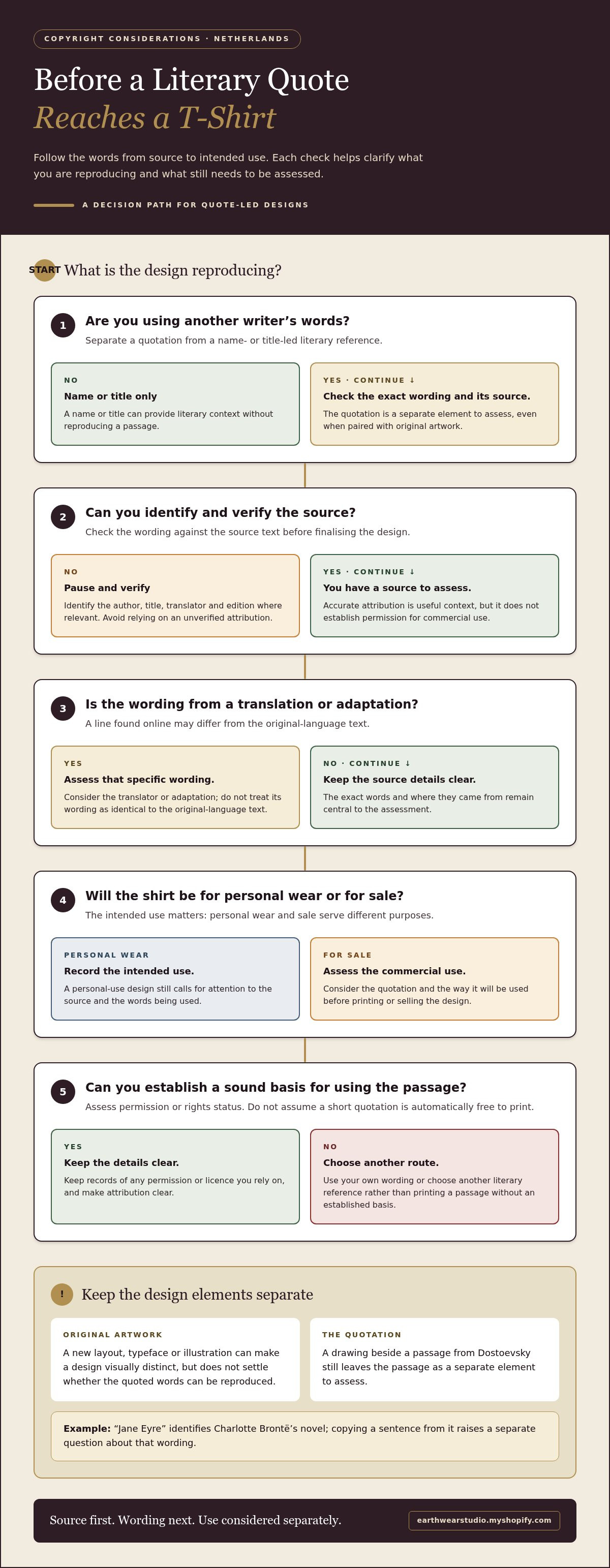
Copyright considerations for printing quotes on T-shirts
Yes. You can create your own literary quote T-shirt design in the Netherlands. If you use another writer’s words, consider the source and intended use before printing or selling the design. Literary quote T-shirts can combine a quotation with original artwork, but each element needs separate consideration.
Start with the exact wording and its source. Note the author, title, translator and edition where relevant. A line attributed to Kafka online may come from a translation or adaptation. Compare the wording with the source text to avoid misattribution. Accurate attribution provides useful context, but does not establish permission for commercial use.
Next, distinguish your contribution from the quoted material. A new layout, typeface or illustration can make a design visually distinct, but it does not settle whether the words can be reproduced. For example, adding an original drawing beside a passage from Dostoevsky still leaves the passage as a separate element to assess.
Consider how you plan to use the design. A shirt made for personal wear and one intended for sale serve different purposes. Keep records of any permission or licence you rely on. If a phrase comes from a translation, assess that specific wording rather than treating it as identical to the original-language text. Do not assume a short quotation is automatically free to print.
Names and titles provide literary context without reproducing a passage. “Jane Eyre” identifies Charlotte Brontë’s novel; copying a sentence from it raises a separate question about that wording. Margaret Atwood has described “Nolite te bastardes carborundorum” as mock Latin, but that description does not determine whether using it on clothing is permitted.
Before finalising literary quote T-shirts, identify the source, establish who wrote or translated the words, and clarify the intended use. Then assess permission or rights status, and keep attribution clear. If you cannot establish a sound basis for using a passage, choose your own wording or another literary reference.
How do I choose the right size for a literary quote T-shirt?
Start with a T-shirt you already wear comfortably, not a size label. Lay it flat and measure the chest width, body length and shoulder width. Compare those measurements with the garment’s size guide. This gives you a practical reference, especially when sizing varies between brands.
For chest width, measure straight across beneath the sleeves. For length, measure from the highest point of the shoulder to the hem. Compare each measurement separately instead of relying on a single “medium” or “large” label. If the guide lists garment dimensions, compare them with your laid-flat shirt, not your body measurements. This is useful for literary quote T-shirts because an oversized cut can make sizing less intuitive.
Next, decide how you want the shirt to fit. For a closer fit, look for measurements near those of your reference shirt. For more room, compare with a shirt that drapes more loosely. An oversized cut already adds volume, so sizing up automatically may create more length and width than you want. Use the shoulder and body measurements to judge the effect before choosing literary quote T-shirts.
- Measure: Record chest width, length and shoulder width from a shirt you own.
- Compare: Check each figure against the size guide for the garment.
- Choose: Prioritise the measurement that most affects your preferred fit.
Consider the printed text, too. A quote across the chest may sit differently as the fabric drapes or stretches. Think about whether you want the lettering clearly visible when wearing the shirt open over another layer, or prefer a relaxed silhouette. The garment’s measurements help you decide before selecting a size.
If you fall between sizes, use your priority measurement to decide. Choose the size whose chest or shoulder width best matches your intended fit, then check the length. Follow the care label to maintain the garment as intended. Explore literary quote T-shirt designs and compare the fit information before choosing.
Earthwear Studio: Literary-quote oversized T-shirts
Earthwear Studio offers oversized literary-quote T-shirts for readers who want a favourite line in their everyday wardrobe. Its designs include references to Gogol, Dostoevsky and Kafka, each with a distinct literary voice. The shirts pair short quotations with an oversized, unisex fit and organic cotton.
Choose a design by the writer whose work you return to, then consider how the quote’s meaning and placement suit your style. A Gogol reference may appeal to readers drawn to satire; Dostoevsky and Kafka offer different literary points of departure. The oversized cut creates a relaxed silhouette, so compare the garment measurements with a shirt you already wear before choosing a size.
Visit Earthwear Studio’s literary-quote T-shirts to explore the designs.
Choose a Line Worth Carrying
A quotation on clothing becomes part of how you move through ordinary days. Choose words that still mean something to you beyond the page, and give their source the care it deserves. Let the phrase reflect your own reading, not just its recognisability.
For a considered literary reference, Earthwear Studio offers oversized literary-quote T-shirts, including designs associated with Gogol and Dostoevsky. Explore the words and fit at your own pace. A well-chosen line need not explain itself to everyone; its significance can remain personal, carried quietly into daily life.
If that feels like the right next step, explore literary quote T-shirts at Earthwear Studio. Find a design that gives a familiar thought a place beyond the book, and make it part of your everyday wardrobe.
Frequently Asked Questions
Which fabrics and printing methods help a quote T-shirt last?
For literary quote T-shirts, fabric quality and print placement both affect how the design wears. A tightly woven cotton surface can provide a stable base for clear lettering. Check how the print responds to repeated washing, then follow the garment’s care label. Avoid stretching the printed area when dressing, since tension across the chest can strain the design over time.
Are famous literary quotes copyrighted for use on T-shirts?
A quotation is not free to reproduce simply because it is famous. For literary quote T-shirts intended for sale, identify the exact edition and translation behind the words, then determine whether permission or another legal basis applies. Wording can vary across translations, so record the version used in your artwork. Crediting the author helps readers trace the source, but attribution alone does not establish permission.